AI search
Patients ask AI who to see. The answer names a few practices and stops.
Here is how those answers get made, what moves a practice into them, and how to see the real answer for your own practice in about a minute.
How an AI answer gets made
The sources are the part you can change.
A patient asks a question
"Who is the best full-arch implant dentist near me?" or "What does All-on-4 cost in my city?"
The AI reads what it can find
Practice websites, Google reviews and listings, directories and local articles.
It writes a short answer
Usually three or four practices by name, often with links to the pages it drew on. Many patients stop reading there.
What the answers draw on
The companies behind these tools do not publish how they choose.
These are the kinds of sources their answers cite, and the four things our work builds.
- Page
A page about the specific treatment
A full-arch or All-on-4 page that says who it is for, what it involves, what it costs and how to pay for it. A general "dental implants" page gives an answer less to quote.
- Reviews
Reviews that describe the treatment
A hundred reviews praising a friendly front desk say little about implants. Reviews from implant patients, in their own words, do.
- Listing
A complete Google Business Profile
The right categories and services, and a name, address and phone number that match everywhere they appear.
- Speed
A site that loads on a phone
Pages that take too long to show their content are harder for patients, and for crawlers, to read.
How we measure it
Five questions, three engines, the real answer.
The Market Check asks the questions a patient asks, in your city, and shows you the actual answer with the practices it named. These are real screens from a sample practice; the names are fictional.
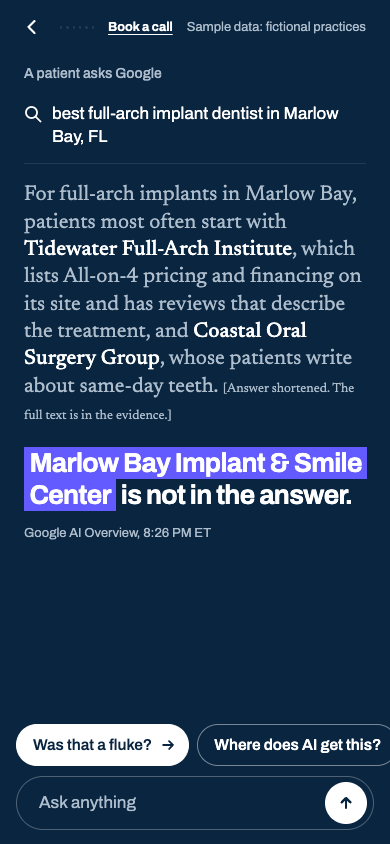
What AI told a patient
The exact answer to "best full-arch implant dentist" in your city, with your name in it or not.
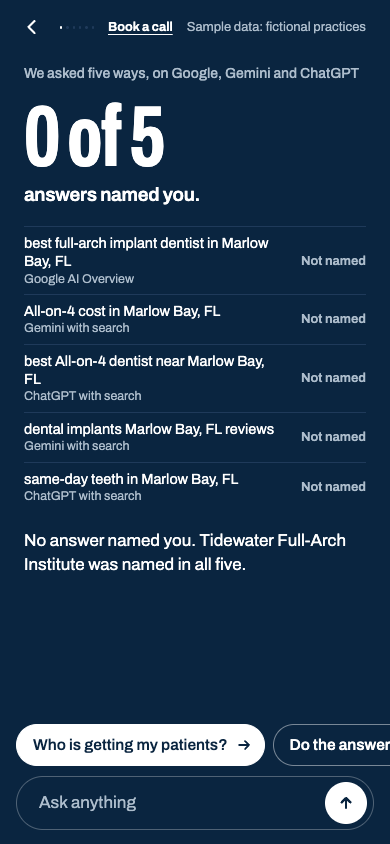
How often your name comes up
Five questions patients actually type, across Google, ChatGPT and Gemini. If someone else is named in most of them, we say who.
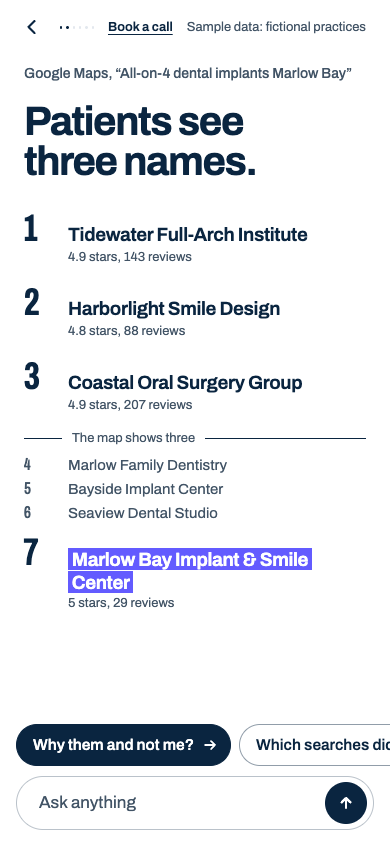
Who patients see first on Maps
The three practices a patient sees before scrolling, searched from your own address. Then where you sit.
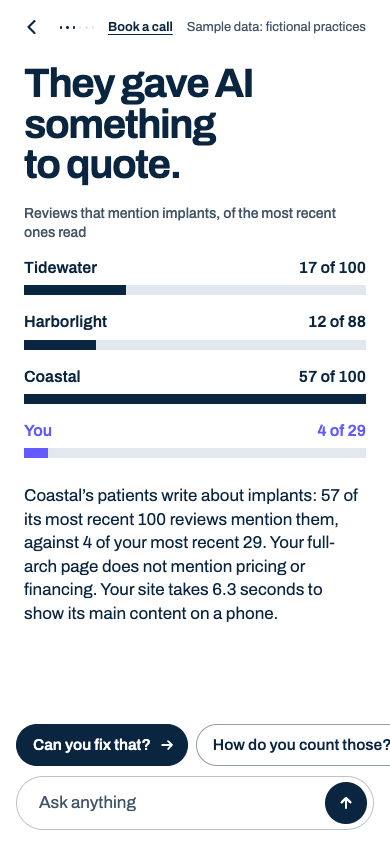
What your reviews give AI to quote
How many of your recent reviews mention implants, next to the practices above you.
What nobody can promise
A guaranteed place in an AI answer.
Answers change from one run to the next. Anyone who guarantees a position is guessing. We measure a sample, build the inputs, and measure again. The thing we do guarantee is booked consults.
-
Is this the same as SEO?
It overlaps. The same pages, reviews and listings feed both Google results and AI answers. The difference is the result: a list of links lets a patient scroll, while an AI answer names three or four practices and stops.
-
Can you get my practice into ChatGPT's answers?
Nobody can guarantee that. We can check whether you are named today, show you what the answer cited, and build the things it draws from. Then we check again.
-
How do you check?
We ask five questions a patient would ask, across Google AI Overview, ChatGPT and Gemini with web search on, and record which practices each answer named and what it cited. Because answers vary between runs, we treat the result as a sample of five, not a ranking.
-
How is this different from AI lead software?
Lead software manages the enquiries you already have. This is about whether AI sends you any in the first place. A practice can use both.
Free · about a minute · no sign-up
See what AI says about your practice.
We ask Google, ChatGPT and Gemini the questions a full-arch patient asks, and show you the answer with the source next to every number.